
Event Planning 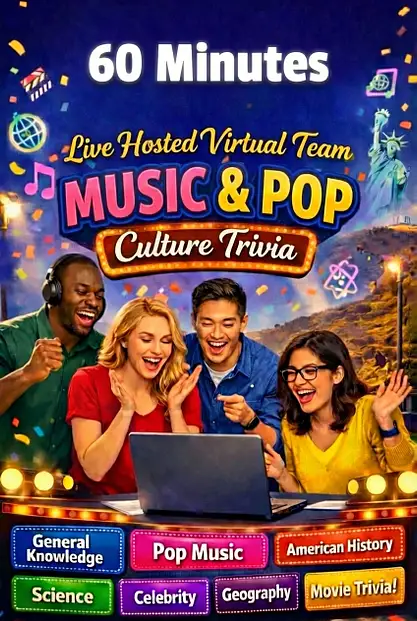 Check Availability & Book
Check Availability & Book
Check Availability & Book
The Best Pop Culture Categories for Virtual Trivia Night
November 3, 2025 8 min read
You can have a perfectly organized trivia night with great tech, a solid team format, and enthusiastic participants. But if the categories are boring, the whole thing falls flat. The categories are the engine. They determine whether people lean in or tune out, whether teams argue passionately about answers or shrug and move on.
After hosting hundreds of virtual trivia events for companies of every size, we have found that certain pop culture categories consistently outperform others. Not because they are harder or easier, but because they tap into something people genuinely care about.
Here are the categories that generate the most energy, the loudest reactions, and the strongest team bonding.
Name That Tune
If we could only run one category for the rest of time, it would be this one. Name That Tune generates more emotional reactions per question than any other format. There is something about hearing the opening notes of a song that bypasses the analytical brain and goes straight to memory and feeling.
The format is simple. Play a short audio clip, and teams race to identify the song and artist. But the magic is in the curation. The best Name That Tune rounds alternate between decades and genres so the advantage keeps shifting. A Motown classic followed by a 2020s pop hit followed by a 90s grunge anthem ensures no single age group dominates.
What makes it work for team building specifically is the collaboration it forces. One person recognizes the melody but can’t name the artist. Another knows the artist but has the song title wrong. A third person has been humming along and suddenly blurts out the correct answer. That collective problem-solving, happening in real time under a countdown clock, is genuine teamwork. It is one of the ways pop culture trivia builds real team connection that other formats simply cannot replicate.
About Your Host: Pop Culture Expert and Radio Host Scott Topper
Every category hits differently depending on who is running the show. Scott Topper is an Emmy Award-winning TV and radio host who has spent his career at the intersection of entertainment and audience connection. As a pop culture expert and radio host, Scott knows which categories need high energy, which ones need breathing room, and how to transition between them so the event flows naturally.
“Categories are not just topics. They are mood shifts,” Scott explains. “A Name That Tune round should feel electric. A movie quote round should feel playful. A decade battle should feel like a rivalry. The host’s job is to set the emotional tone for each one.”
🎵 Virtual Team Music & Pop Culture Trivia Game Show
Categories include General Knowledge, Pop Music, World History, Science, Celebrity, Geography, and Movie Trivia!
$300 up to 10 people
$25 each additional participant
Movie and TV Quotes
“You can’t handle the truth.” “I’ll be back.” “That’s what she said.”
Movie and TV quotes tap into a shared cultural vocabulary that most people carry around without realizing it. When a quote appears on screen and someone on your team recognizes it instantly, there is a flash of pride and connection that goes beyond trivia.
The best quote rounds mix iconic lines with slightly obscure ones. Everyone knows “May the Force be with you.” But “I’m not superstitious, but I am a little stitious” separates the casual fans from the devoted ones. That mix of easy and challenging keeps everyone engaged because even if you miss one, the next question might be your moment.
Quote rounds also spark great side conversations. “Wait, that line is from THAT movie?” is a reaction we hear at almost every event. Those small discoveries become shared references that teams carry back to work.
Album Covers and Movie Posters
Visual rounds change the dynamic of trivia in a way that keeps things fresh. Instead of processing a text question, teams are looking at an image and working together to identify it. This engages a completely different part of the brain and gives visual thinkers their moment to contribute.
Album cover identification is particularly effective because it rewards a type of knowledge that does not come up in normal conversation. Someone might not consider themselves a music expert, but they have scrolled past a specific album cover hundreds of times on a streaming platform and can recognize it from a blurry crop. That unexpected knowledge feels great to discover about yourself and your teammates.
The zoomed-in variant takes this further. Show a tiny detail of an iconic album cover or movie poster and watch teams debate what they are looking at. The reveal always gets a big reaction, whether teams nailed it or were completely wrong.
Decade Battles
Assign each team a decade to represent, and suddenly the stakes feel personal. You are not just answering questions. You are defending the cultural honor of the 80s, or proving that the 2000s produced the best music, or arguing that 90s television was peak entertainment.
This format works because it gives teams an identity beyond their company department or project group. For 60 minutes, you are not the marketing team. You are Team 90s, and you have strong opinions about whether Nirvana or Pearl Jam was more influential. We break down how to build pop culture trivia questions every generation can answer so that decade battles stay competitive for every age group.
Decade battles also create natural trash talk opportunities that are safe and fun. “Your decade gave us disco. You’re welcome” becomes the kind of lighthearted banter that makes remote work feel less transactional. Pop culture expert and radio host Scott Topper leans into these rivalries during events, playing decades off each other in a way that builds friendly competition without crossing into anything uncomfortable.
Celebrity “Who Am I?” Rounds
Read a series of increasingly specific clues about a famous person, and teams try to identify them as early as possible. The earlier you guess correctly, the more points you earn. But guess wrong and you lose points.
This format creates a fascinating risk-reward dynamic within teams. Someone thinks they know the answer after the first clue but is not sure. Do they lock in for maximum points or wait for another clue? That internal debate, happening live within a team, is the kind of collaborative decision-making that mirrors real workplace dynamics.
The clue structure also matters. Start with something vague (“This person was born in the Midwest”) and gradually get more specific (“They starred in a movie that won Best Picture” then “They are known for a specific catchphrase”). The progression builds suspense and gives different team members entry points based on what they know.
Internet and Viral Culture
This is the category that gives younger team members their time to shine. In most workplace settings, experience and seniority carry weight. But when a question about a viral TikTok trend or a classic meme format comes up, the usual hierarchy inverts. The intern becomes the authority, and the VP is genuinely learning something.
That inversion is valuable for team dynamics. It signals that different types of knowledge are valued and that expertise is not just a function of years on the job.
Balance this category with some “vintage internet” questions covering early YouTube, original memes, and pre-smartphone viral moments. This gives the 30-plus crowd a foothold and creates funny moments when younger team members learn about the internet’s chaotic early days.
How Categories Flow Together
The order of categories matters as much as the categories themselves. Here is a flow that pop culture expert and radio host Scott Topper uses to build energy throughout an event:
Open with Name That Tune. It is high energy, immediately engaging, and gets people talking from the first question. This sets the tone for everything that follows. Scott shares more on opening strong in his pop culture trivia tips from an Emmy TV host.
Follow with a visual round. The shift from audio to visual keeps things fresh and engages different team members. Album covers or movie poster identification works well here.
Mid-event: quotes or decade battles. By this point teams are warmed up and competitive. Quote rounds reward deep knowledge, and decade battles channel that competitive energy into something playful.
Close with celebrity “Who Am I?” or rapid fire. The risk-reward format creates dramatic moments that make for a strong finish. Teams are invested by now, and the format rewards bold plays.
Weave internet culture throughout. Rather than dedicating a full round to viral content, sprinkle internet culture questions into other rounds as wildcards. This keeps younger team members engaged throughout instead of waiting for “their” round.
Try It Live
Our Music & Pop Culture Trivia Game Show uses all of these categories in a professionally paced 60-minute format. Every round is curated for maximum engagement, and your live host adapts the energy in real time based on your team’s reactions.
🎵 Virtual Team Music & Pop Culture Trivia Game Show
Categories include General Knowledge, Pop Music, World History, Science, Celebrity, Geography, and Movie Trivia!
$300 up to 10 people
$25 each additional participant