
Event Planning 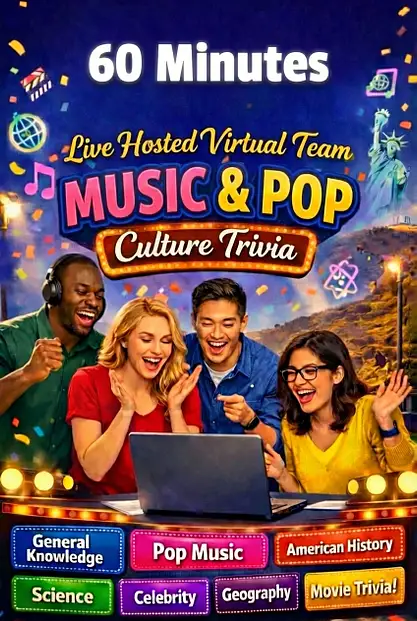 Check Availability & Book
Check Availability & Book
Check Availability & Book
Pop Culture Trivia Tips from an Emmy TV Host
February 9, 2026 7 min read
Running great trivia looks easy from the outside. Read the questions, keep score, announce the winner. But anyone who has actually tried to host a trivia night knows that the gap between “fine” and “incredible” is enormous. The questions matter. The pacing matters. The energy matters. And the host’s ability to read the room and adapt in real time is what separates a forgettable hour from one that people talk about for weeks.
Scott Topper has hosted over 500 virtual trivia events for companies ranging from 10-person startups to Fortune 500 enterprises. As an Emmy Award-winning TV and radio host, he has spent decades learning how to keep live audiences engaged. Here are the lessons he has learned about what makes pop culture trivia work, whether you are hosting it yourself or hiring a professional.
Start Hot
“The first question sets the tone for the entire event,” Scott says. “If you open with something obscure or slow, you lose the room before you’ve even started.”
The opening question should be one that at least half the room can answer, and it should generate an emotional reaction. A Name That Tune clip of an iconic song. A movie quote that everyone recognizes. A celebrity photo from a viral moment. The goal is not to test knowledge. It is to get people reacting, talking, and feeling the energy of the event. (Not sure which categories generate the biggest reactions? Here is our breakdown of the best pop culture categories for virtual trivia.)
Pop culture expert and radio host Scott Topper typically opens with a music clip because audio is the fastest way to trigger an emotional response. “Two seconds of a song can take someone back to a specific memory. That emotional hit right at the start tells people this is going to be fun, not a test.”
Never Let a Wrong Answer Die
One of the biggest mistakes trivia hosts make is moving straight from a wrong answer to the correct one. “That’s incorrect. The answer was actually…” feels deflating. It shuts down the people who guessed wrong and makes them less likely to participate in the next round.
“When a team gives a wrong answer, that is actually an opportunity,” Scott explains. “If someone says the song is by Aerosmith and it is actually by Led Zeppelin, you can riff on that. ‘I can see why you went there, both bands have that big guitar sound.’ Suddenly the wrong answer feels like a reasonable guess instead of a failure.”
This technique keeps participation high because people feel safe being wrong. In a corporate setting where people are often cautious about looking foolish in front of colleagues and managers, that psychological safety is critical for engagement. That safety is also one of the reasons pop culture trivia builds real team connection in ways that other activities struggle to match.
About Your Host: Pop Culture Expert and Radio Host Scott Topper
Scott Topper’s approach to trivia hosting comes from his background in live broadcast. As a pop culture expert and radio host with an Emmy Award on his shelf, Scott has spent years learning how to connect with audiences in real time. His radio background is especially relevant because radio is an intimate medium where the host’s energy and personality carry the entire experience.
“On radio, you don’t have visuals to rely on. You have to create energy and connection purely through voice, timing, and personality,” Scott says. “That translates directly to virtual events, where you are essentially performing through a small rectangle on someone’s screen.”
That broadcast discipline shows up in every aspect of how Scott runs trivia. The pacing is tight without feeling rushed. Transitions between rounds are smooth. Dead air is nonexistent. The whole thing feels produced, in the best sense of the word.
🎵 Virtual Team Music & Pop Culture Trivia Game Show
Categories include General Knowledge, Pop Music, World History, Science, Celebrity, Geography, and Movie Trivia!
$300 up to 10 people
$25 each additional participant
Pace by Energy, Not by Clock
“Most trivia hosts pace their events by time. ‘We have 10 minutes for this round, 10 minutes for the next one.’ That is a mistake,” Scott says. “You should pace by energy.”
What does that mean in practice? If a round is generating huge reactions and teams are deeply engaged, let it breathe a little longer. If a round is dragging, cut it short and move to the next category. The clock is a guide, not a script.
“I always have more material prepared than I need,” Scott explains. “That way I can lean into what is working and skip what is not. The audience never knows the difference. They just know that every minute felt engaging.” Having questions that span every generation makes this flexibility even more powerful because you always have material that will land with different parts of the room.
This flexibility is one of the key advantages of having a live host over a self-guided trivia platform. An app runs on a fixed timer regardless of how the audience is responding. A skilled host adapts in real time.
Use the Chat as a Second Stage
In virtual events, the chat is not just a communication tool. It is a performance space. Pop culture expert and radio host Scott Topper treats the Zoom chat as an extension of the event itself.
“I call out great chat messages by name. ‘Sarah in accounting says her team definitely deserves bonus points for that answer. Bold move, Sarah.’ That kind of acknowledgment makes people feel seen, and it encourages more chat participation.”
The chat also serves as a real-time gauge of audience energy. When messages are flying, the room is engaged. When the chat goes quiet, something needs to shift. Experienced hosts monitor the chat constantly and use it to inform their pacing and energy decisions.
Tips for using the chat effectively:
- Encourage reactions, not just answers. Ask teams to drop their confidence level (1-10) before revealing an answer. The range of responses creates a mini-drama before the reveal.
- Create chat-only bonus questions. “First person to type the answer in chat gets bonus points” changes the dynamic and rewards speed over deliberation.
- Read chat reactions out loud. When someone types “NO WAY” or “I KNEW IT,” acknowledging that reaction amplifies the energy for everyone.
Make the Bonus Wheel Matter
“The Bonus Wheel is not just a gimmick. It is a pacing tool,” Scott says. “When energy dips, a Bonus Wheel spin resets the room. When a team is trailing, a lucky spin gives them hope. It adds an element of chance that keeps the outcome uncertain until the very end.”
The key is making the wheel feel consequential. If the prizes on the wheel are trivial, the spin loses its energy. But if a spin can double a team’s score or steal points from the leader, suddenly everyone cares.
Scott structures the wheel to include a mix of point bonuses, point swaps, and wildcard outcomes. “The occasional ‘lose half your points’ result creates a genuine gasp moment. Drama is entertainment. And entertainment is what keeps people engaged.”
Close with a Bang, Not a Whimper
“The last five minutes of a trivia event determine how people remember the entire experience,” Scott says. “Peak-end rule. People remember the peak moment and the final moment. So you need to make sure the ending is strong.”
This means building toward a dramatic finish. Save the most competitive round for last. Keep the scores close heading into the final questions. Create a moment where the outcome genuinely hangs in the balance.
“I sometimes hold back a team’s score reveal until the very last question. The suspense of not knowing exactly where you stand makes the final answer feel like it could change everything,” Scott explains. “Even if it can’t, the feeling that it might is what creates the energy.”
Bring These Tips to Your Next Event
Want to experience all of this firsthand? Our Music & Pop Culture Trivia Game Show is hosted live by Emmy TV and Radio Host Scott Topper, who brings every one of these techniques to your team’s event. No prep, no downloads, just 60 minutes of professionally hosted fun.
🎵 Virtual Team Music & Pop Culture Trivia Game Show
Categories include General Knowledge, Pop Music, World History, Science, Celebrity, Geography, and Movie Trivia!
$300 up to 10 people
$25 each additional participant