
Event Planning 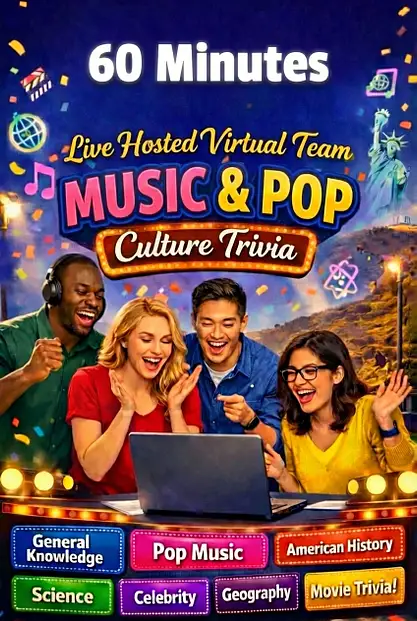 Check Availability & Book
Check Availability & Book
Check Availability & Book
Pop Culture Trivia Questions Every Generation Can Answer
July 28, 2025 8 min read
One of the biggest mistakes people make when planning pop culture trivia is building the whole thing around a single era. If every question is about 80s hair bands or 2020s TikTok trends, half your team checks out before the second round. The best trivia events feel like everyone gets a moment to be the expert, regardless of when they were born.
That is the whole philosophy behind how we structure our Music & Pop Culture Trivia Game Show. The question sets are designed so that no single generation dominates, and every round surfaces surprising knowledge from unexpected people.
Here is how to think about building pop culture trivia that works across every age group on your team.
Why Generational Range Matters More Than Difficulty
Most trivia hosts obsess over getting the difficulty level right. Too easy and it feels boring. Too hard and people disengage. But difficulty is actually the wrong variable to optimize for. What you really want is range.
A question about Fleetwood Mac’s “Rumours” is easy for someone in their 50s and genuinely hard for a 24-year-old. A question about Olivia Rodrigo’s debut album flips that dynamic completely. Neither question is inherently easy or hard. They just reward different lived experiences.
When you build a trivia set with that kind of range, something interesting happens. Teams start relying on each other. The senior director defers to the intern on K-pop questions. The intern defers to the senior director on classic rock. Hierarchies dissolve and genuine collaboration kicks in. That dynamic is exactly how pop culture trivia builds real team connection.
About Your Host: Pop Culture Expert and Radio Host Scott Topper
Scott Topper is an Emmy Award-winning TV and radio host who has hosted over 500 virtual events for companies like Google, Salesforce, Amazon, and Netflix. As a pop culture expert and radio host, Scott has spent years curating questions that land with every demographic. His broadcast background means he reads the room in real time, adjusting pacing and energy based on which rounds are hitting and which need a boost.
“The best trivia nights are the ones where a quiet team member suddenly becomes the hero because they happen to know everything about 90s hip-hop or Broadway musicals,” Scott says. “That moment when someone unexpected carries the team is what people remember weeks later.”
🎵 Virtual Team Music & Pop Culture Trivia Game Show
Categories include General Knowledge, Pop Music, World History, Science, Celebrity, Geography, and Movie Trivia!
$300 up to 10 people
$25 each additional participant
Pop Culture Categories That Work for Every Generation
Here are categories we have found consistently engage mixed-age teams:
Music Across the Decades
Structure rounds by decade rather than genre. A 70s round, an 80s round, a 90s round, a 2000s round, and a 2010s-2020s round gives every generation at least one home turf advantage. Within each decade, mix genres so even people who lived through that era get challenged. Not everyone who remembers the 80s was listening to Duran Duran. Some were listening to Run-DMC.
Name That Tune clips are especially powerful here because they trigger instant emotional recognition. Two seconds of a song can take someone back to a specific memory, and that emotional response is what makes the experience stick. It is one of the best pop culture categories for virtual trivia across every age group.
Movies and TV Shows
This is where generational range really shines. A question about “The Breakfast Club” and a question about “Squid Game” test completely different knowledge bases, but both generate real enthusiasm from the people who know the answer.
Visual rounds work particularly well for this category. Show a single frame from a movie and ask teams to identify it. People who have watched a film twenty times can spot it from a blurry screenshot. People who haven’t seen it are genuinely impressed when their teammate nails it.
Viral Moments and Internet Culture
This category skews younger, which is exactly why you need it. In most workplace settings, younger employees defer to more experienced colleagues. A round on viral memes, TikTok trends, or internet culture gives newer team members a chance to lead. That inversion of the usual dynamic is valuable for team cohesion.
Balance it with a “classic internet” sub-round covering early YouTube, original memes, and pre-smartphone viral content to give the 30-and-over crowd a foothold.
Celebrity and Entertainment News
Celebrity trivia is the great equalizer because it cuts across age groups in unpredictable ways. A question about a celebrity’s early career might surprise younger team members who only know them from recent work. A question about a recent awards show controversy tests whether the older team members are keeping up with current events.
The key is mixing eras. Don’t make it all about current celebrities or all about classic Hollywood. Alternate between decades so the advantage keeps shifting.
Sports and Pop Culture Crossovers
Questions about athletes who crossed over into entertainment, halftime show performances, sports movies, and athlete endorsements hit a sweet spot between sports fans and pop culture fans. This category often engages people who wouldn’t describe themselves as either sports buffs or pop culture enthusiasts, because the crossover territory feels fresh.
Building Your Question Set: Practical Tips
If you are putting together your own pop culture trivia, here are some guidelines that pop culture expert and radio host Scott Topper follows when curating question sets:
Alternate decades deliberately. Don’t cluster all the 80s questions together. Interleave them so the advantage swings back and forth within each round.
Include at least one “everyone knows this” question per round. A question so iconic that most people will get it builds confidence and keeps the energy high. Think “What movie features the line ‘I’ll be back’?” level of universality.
Add one genuine stumper per round. The contrast between the easy questions and the hard ones creates drama. When a team nails the stumper, it feels like a genuine accomplishment.
Mix question formats. Audio clips, visual rounds, multiple choice, and open-ended questions all engage different parts of the brain. Variety keeps people from settling into a passive rhythm.
Test your questions on people outside your age group. If you are in your 30s, run your questions by someone in their 20s and someone in their 50s. What seems obvious to you might be impossible for them, and vice versa.
Why a Live Host Makes Generational Trivia Work
The single biggest difference between a great pop culture trivia night and a mediocre one is the host. A live host can sense when a round is losing steam and pick up the pace. They can add context to questions that help less knowledgeable teams stay engaged. They can turn a wrong answer into a funny moment instead of an awkward silence. Scott shares more of these techniques in his pop culture trivia tips from an Emmy TV host.
Pop culture expert and radio host Scott Topper brings decades of live broadcast experience to every event. His ability to connect with audiences of every age is what makes our virtual trivia events consistently engaging for mixed-generation teams.
When the host genuinely understands pop culture across eras and can riff on answers, add trivia about the trivia, and create moments of connection between team members, the event transcends a simple quiz and becomes a shared experience.
Ready to Try It?
Our Music & Pop Culture Trivia Game Show is built around everything in this article. Professionally curated questions spanning every decade, a live host who reads the room, and a Family Feud-style team format that gets everyone involved.
🎵 Virtual Team Music & Pop Culture Trivia Game Show
Categories include General Knowledge, Pop Music, World History, Science, Celebrity, Geography, and Movie Trivia!
$300 up to 10 people
$25 each additional participant