
Team Building 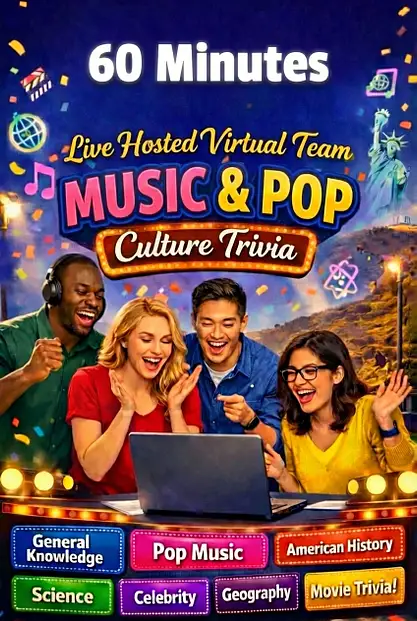 Check Availability & Book
Check Availability & Book
Check Availability & Book
Why Pop Culture Trivia Beats General Knowledge for Team Events
April 22, 2025 7 min read
When companies plan a trivia night, the default instinct is general knowledge. It feels safe. Geography, history, science, literature. Broad enough that everyone has a shot, academic enough that it feels respectable. On paper, it makes perfect sense.
In practice, it almost always underperforms.
We have hosted over 500 virtual trivia events and the pattern is consistent. Pop culture trivia generates louder reactions, more team discussion, higher participation, and more post-event buzz than general knowledge trivia. Not sometimes. Every time.
Here is why, and what it means for how you plan your next team event.
General Knowledge Rewards Individuals. Pop Culture Rewards Teams.
General knowledge trivia tends to have one correct answer that one person either knows or doesn’t. What is the capital of Mongolia? You either know it’s Ulaanbaatar or you don’t. There is not much to discuss. The person on your team who happens to have that fact filed away answers it, and everyone else watches.
Pop culture trivia works differently. “What movie features a character saying ‘I’ll have what she’s having’?” triggers a different kind of cognitive process. People start associating. They picture the scene. They remember watching it with someone. They debate between two possible movies. The question creates conversation, not just recall.
That collaborative dynamic is exactly what makes trivia effective as a team building activity. When people are debating and contributing, they are building the kind of informal connections that carry over into daily work.
The Emotional Gap
General knowledge questions engage the intellect. Pop culture questions engage the emotions. That distinction sounds subtle, but it transforms the entire experience.
When a Name That Tune round plays the opening notes of a song someone loves, their face lights up before they even process the question. That involuntary emotional response is visible on camera, and it is contagious. Other team members see the reaction and get curious. “You know this one? What is it?” Suddenly the whole team is leaning in. Name That Tune is just one of the best pop culture categories for virtual trivia that consistently outperform general knowledge formats.
Compare that to a geography question. Someone might feel satisfied knowing the answer, but they rarely feel excited about it. There is no rush of nostalgia when you correctly identify the longest river in South America.
About Your Host: Pop Culture Expert and Radio Host Scott Topper
The difference between pop culture and general knowledge becomes even more pronounced with a live host who knows how to work the material. Scott Topper is an Emmy Award-winning TV and radio host who brings professional broadcast energy to every virtual event. As a pop culture expert and radio host, Scott amplifies the emotional reactions that make pop culture trivia special.
“When someone nails a question about their favorite band or quotes a movie line perfectly, I can build on that moment,” Scott says. “I can riff on it, connect it to another question, or turn it into a running joke for the rest of the event. General knowledge doesn’t give you those openings. Pop culture gives you dozens of them.”
That ability to create spontaneous moments of connection is what separates a memorable event from a forgettable one.
🎵 Virtual Team Music & Pop Culture Trivia Game Show
Categories include General Knowledge, Pop Music, World History, Science, Celebrity, Geography, and Movie Trivia!
$300 up to 10 people
$25 each additional participant
Pop Culture Is a Universal Language
One of the biggest concerns people have about pop culture trivia is that it might be too niche. “What if someone doesn’t watch movies?” or “What if they don’t listen to popular music?” These concerns are understandable but almost never play out in reality.
Pop culture is ambient. You absorb it whether you try to or not. You have heard “Bohemian Rhapsody” even if you have never bought a Queen album. You know what a lightsaber is even if you have never watched Star Wars start to finish. You can identify the theme from “The Office” even if you have only seen clips on social media.
General knowledge, by contrast, is studied. You know the periodic table because you took chemistry. You know European capitals because you studied geography. If you didn’t study those things, you simply don’t know them, and no amount of ambient exposure will help.
This means pop culture trivia has a much wider participation floor. People who would sit quietly through a science round will actively contribute during a music or movie round because they have been passively accumulating that knowledge their entire lives.
The Water Cooler Effect
After a general knowledge trivia event, the conversation the next day is usually “Our team won” or “That was fun.” Brief and transactional.
After a pop culture trivia event, the conversations go deeper. “I can’t believe you knew every Beyonce album in order.” “Your Seinfeld impression during the quote round was incredible.” “I had no idea you were such a horror movie fan.” These observations about teammates become the building blocks of real workplace relationships.
Pop culture expert and radio host Scott Topper calls this the “water cooler multiplier.” The event itself is 60 minutes, but the conversations it generates carry on for days. Inside jokes form. People share playlists based on the music rounds. Someone starts a movie recommendation thread in Slack. The trivia night becomes a catalyst for ongoing connection rather than a one-time event. We dive deeper into this phenomenon in how pop culture trivia builds real team connection.
When General Knowledge Does Work
To be fair, general knowledge trivia has its place. Academic teams, research organizations, and groups where intellectual rigor is a core cultural value sometimes prefer it. If your team’s identity is built around expertise and learning, general knowledge can reinforce that identity.
But for the vast majority of corporate teams, where the goal is connection, morale, and making remote work feel less isolating, pop culture trivia outperforms general knowledge on every metric that matters.
The Numbers Tell the Story
Across our events, pop culture themed trivia consistently shows:
- Higher camera-on rates. People turn on their cameras when they are emotionally engaged. Pop culture rounds trigger visible reactions that people want to share.
- More team chat activity. Teams send more messages to each other during pop culture rounds because there is more to discuss. General knowledge questions tend to have one person answering while others wait.
- Longer post-event engagement. Teams that play pop culture trivia are more likely to book follow-up events. The experience creates demand for more.
- Broader participation. In general knowledge trivia, one or two people often carry the team. In pop culture trivia, different people shine in different rounds, which distributes participation more evenly. Building trivia questions every generation can answer is key to making that broad participation happen.
Make the Switch
If you have been defaulting to general knowledge for your team events, try pop culture for your next one. Our Music & Pop Culture Trivia Game Show is designed specifically to maximize the engagement advantages that pop culture has over general knowledge. Live-hosted by Emmy TV Host Scott Topper, with professionally curated questions spanning every decade and genre.
Check availability and see the difference for yourself.
🎵 Virtual Team Music & Pop Culture Trivia Game Show
Categories include General Knowledge, Pop Music, World History, Science, Celebrity, Geography, and Movie Trivia!
$300 up to 10 people
$25 each additional participant