
Event Planning 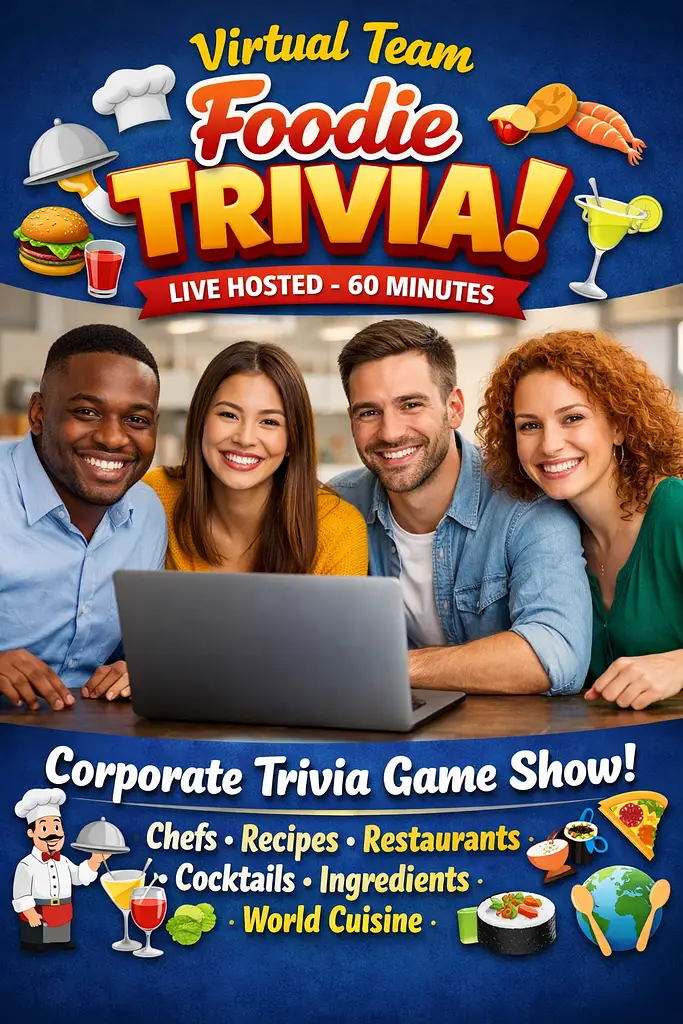 Check Availability & Book
Check Availability & Book
Check Availability & Book
Foodie Trivia Categories That Get Every Team Talking
November 17, 2025 8 min read
A foodie trivia night lives or dies by its categories. Get them right and your team will be debating answers, sharing food memories, and discovering hidden culinary expertise they never knew their coworkers had. Get them wrong and you end up with a quiz that feels like a cooking school entrance exam.
After hosting hundreds of virtual trivia events, we know exactly which food categories generate the most energy, the biggest reactions, and the strongest team conversations. Here are the ones that work every time.
World Cuisine Showdown
This is the category that consistently generates the most discussion. “Which country’s national dish is ceviche?” is not just a geography question. It is an invitation for someone on your team to share their trip to Lima, or to argue that the best ceviche they have ever had was actually in Mexico City, or to ask what ceviche even is.
World cuisine questions work because they reward both travel experience and cultural knowledge. The team member who has never left the country but watches every food documentary on Netflix might know that rendang originates from West Sumatra. The teammate who studied abroad in Seoul knows exactly what banchan refers to. Different life experiences create different expertise, and that diversity of knowledge is what makes team trivia engaging. It is also why foodie trivia is the most fun virtual team activity.
Structure this category as a rapid-fire tour of global cuisine. Jump from continent to continent so the advantage keeps shifting. A Japanese question followed by a Mexican one followed by an Ethiopian one ensures that no single team member can dominate the entire round.
About Your Host: Pop Culture Expert and Radio Host Scott Topper
Categories only work if the host knows how to work them. Scott Topper is an Emmy Award-winning TV and radio host who has hosted over 500 virtual events. As a pop culture expert and radio host, Scott understands that food categories are conversation starters disguised as trivia questions.
“Every food question has a story behind it,” Scott says. “When I ask about the origin of tikka masala and a team gets it right, I don’t just confirm the answer and move on. I pull on the thread a little. Was it really invented in Glasgow? That kind of detail gets people reacting, and those reactions are what make the event memorable.”
🍕 Virtual Team Foodie Trivia Game Show
Categories include Chefs, Recipes, Restaurants, Cocktails, Ingredients, and World Cuisine Trivia!
$300 up to 10 people
$25 each additional participant
Cooking Competition TV
MasterChef, Chopped, The Great British Bake Off, Top Chef, Iron Chef. Cooking competition shows have become a massive part of pop culture, and questions about them generate enthusiastic responses from a surprisingly wide audience.
The reason is emotional investment. People do not just watch these shows passively. They have favorites. They have opinions about eliminations. They remember specific episodes where someone made a stunning dessert or completely botched a protein. Tapping into that emotional connection turns a trivia question into a trigger for shared enthusiasm.
Mix classic and current shows to ensure generational range. A question about the original Japanese Iron Chef reaches a different audience than a question about a recent season of The Great British Bake Off. Both are valid, and the contrast keeps the round fresh.
Pop culture expert and radio host Scott Topper finds that cooking show questions are a natural bridge between food knowledge and entertainment knowledge. “Even people who don’t cook at all watch cooking shows. It is one of those categories where self-identified non-foodies suddenly become experts.”
The Spice Round
Spices are the secret weapon of foodie trivia. They are visual, aromatic, globally diverse, and full of surprising facts. A photo identification round where teams look at close-up images of spices and try to name them creates a completely different dynamic than text-based questions.
Start with recognizable spices like cinnamon sticks and whole peppercorns. Move to moderately challenging ones like cardamom pods and whole star anise. Finish with genuinely difficult ones like dried galangal or grains of paradise. The escalating difficulty creates natural drama.
The history of spices is equally rich territory. The fact that wars were fought over nutmeg, that saffron is worth more than gold by weight, and that vanilla comes from an orchid all sound like inventions but are true. These “no way” facts generate the loudest reactions.
Street Food Around the World
Street food questions have an energy that fine dining questions lack. There is something democratic about street food that makes people more willing to participate. A question about where to find the best banh mi does not feel elitist. It feels like a conversation you would have with a friend.
This category also surfaces hidden expertise in unexpected ways. The intern who spent a gap year in Southeast Asia becomes the resident authority on satay and roti canai. The finance manager who grew up in Mexico City has strong opinions about the best taco al pastor technique. These moments of unexpected expertise are exactly what makes trivia effective as team building.
Structure street food questions by region for maximum variety. A round that covers Mexican street corn, Japanese takoyaki, Turkish kebabs, and Indian chaat takes the team on a culinary tour that everyone finds interesting regardless of their personal food preferences.
Food Myths and Misconceptions
“Does searing meat actually lock in juices?” Most people believe it does. The answer is no, and that surprise is what makes food myth questions so effective. They challenge assumptions that people hold confidently, which creates a specific kind of energy that other categories do not match.
Every wrong answer in a food myth round feels justified because the myths are so widely believed. That shared experience of being wrong together is actually a bonding moment. Teams laugh about being fooled, and the correct answers become genuine learning moments that people remember. We cover more question styles like these in our guide to the best food trivia questions for virtual team building.
Other great food myths to explore: MSG is not actually harmful. White chocolate is not technically chocolate. Twinkies do not last forever. Each one generates a reaction, and the accumulation of surprised reactions builds energy throughout the round.
Dessert and Candy Identification
Sweet treats are universally beloved, and dessert rounds bring a playful energy that balances the more knowledge-heavy categories. Show photos of desserts from around the world and ask teams to name them. A slice of baklava, a plate of mochi, a tower of croquembouche. The visual appeal of desserts makes these rounds genuinely fun to look at, even on a screen.
Candy brand identification is a variation that taps into nostalgia. Show a candy wrapper or describe a candy’s characteristics and watch teams race to identify it. These questions trigger childhood memories and often reveal generational differences. The candy that was everywhere in the 90s might be completely unknown to someone who grew up in the 2010s.
Wine, Beer, and Cocktail Rounds
Beverage categories add variety and bring out a different set of experts. The teammate who knows everything about cooking techniques might draw a blank on wine regions, while the teammate who seemed disengaged during the ingredient round suddenly comes alive when cocktail origins come up.
Keep this category inclusive by mixing alcoholic and non-alcoholic beverages. The history of tea, the global coffee belt, and the rise of craft sodas are all rich territories. Questions about beverage pairings bridge the gap between food knowledge and drink knowledge in a way that feels natural.
Pop culture expert and radio host Scott Topper uses beverage rounds as a palate cleanser between heavier food categories. “A cocktail question between a cooking technique round and a food history round changes the energy. It keeps people from getting too deep into one type of knowledge and resets the playing field.”
How to Sequence These Categories
The order you play these categories in matters as much as the categories themselves. Here is a sequence that consistently builds energy:
Open with street food or fast food. Universal, low-barrier, opinion-heavy. Gets everyone talking immediately.
Second round: world cuisine showdown. Broadens the scope and brings in team members with international knowledge or travel experience.
Mid-event: cooking competition TV and food myths. By now the room is engaged. Entertainment questions reward a different type of knowledge, and myth-busting questions surprise everyone equally.
Late round: the spice round or ingredient identification. Visual rounds create a gear shift that reengages attention after text-heavy rounds.
Close with dessert and beverage questions. Sweet and fun, these categories create a positive emotional note to end on. Scott shares more on pacing and closing strong in his foodie trivia hosting tips.
Experience It Live
Our Foodie Trivia Game Show uses all of these categories in a live-hosted 60-minute format. Every round is paced by your team’s energy, and your host Scott Topper adapts in real time to maximize engagement.
🍕 Virtual Team Foodie Trivia Game Show
Categories include Chefs, Recipes, Restaurants, Cocktails, Ingredients, and World Cuisine Trivia!
$300 up to 10 people
$25 each additional participant