
Event Planning 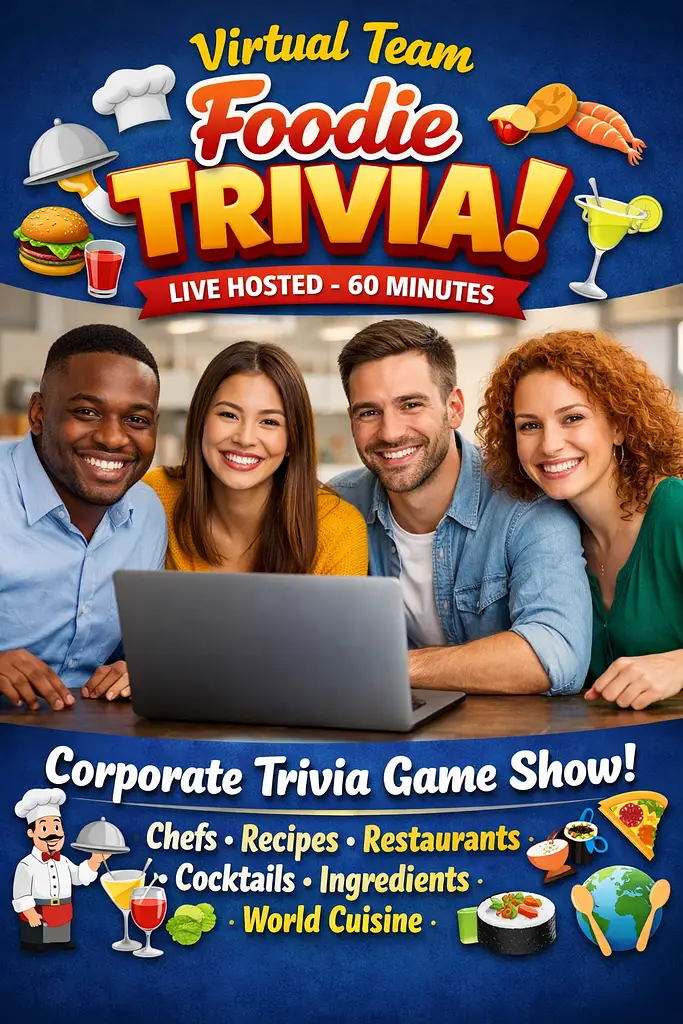 Check Availability & Book
Check Availability & Book
Check Availability & Book
Foodie Trivia Hosting Tips from an Emmy Award-Winning TV Host
March 17, 2026 7 min read
Hosting foodie trivia looks simple. Read food questions, score answers, declare a winner. But anyone who has run a food-themed trivia night knows that the gap between a flat quiz and an event people rave about is enormous. The questions matter. The pacing matters. The host’s ability to turn a trivia answer into a conversation matters most of all.
Scott Topper has hosted over 500 virtual trivia events for companies of every size. As an Emmy Award-winning TV and radio host, he has spent decades learning how to hold an audience’s attention and create moments that stick. Here is what he has learned about making foodie trivia work at its highest level.
Lead with Something Everyone Can Taste
“The opening question determines whether people lean in or lean back,” Scott says. “With food trivia, you have an advantage that other formats don’t. You can start with something that triggers a sensory memory.”
A question about a universally known food, something like the origin of pizza or the ingredients in a classic PB&J, gets the room engaged before anyone has to think hard. The goal of the first question is not to challenge. It is to connect. Everyone has an experience with the food being discussed, and that shared starting point sets the tone for the rest of the event.
“I sometimes start with a visual of a dish that is instantly recognizable. A perfect slice of New York pizza. A tray of fresh sushi. The image alone gets people reacting in the chat before I have even asked the question. That early engagement is momentum you can build on for the entire hour.”
Food Stories Are More Important Than Food Facts
“The biggest mistake hosts make with foodie trivia is treating it like a cooking exam,” Scott explains. “If every question is about ingredient measurements or technique definitions, you lose everyone who doesn’t cook. And even the cooks get bored because it feels like school.”
The best foodie trivia questions are story questions. Not “What temperature do you bake a sourdough at?” but “Which San Francisco bakery started the sourdough craze that swept the country?” The second question invites conversation, debate, and personal experience. The first one has a number for an answer and nothing to discuss.
Pop culture expert and radio host Scott Topper structures every round around stories and cultural moments rather than technical knowledge. “I want people arguing about whether the cronut was genius or gimmick, not reciting oven temperatures. The argument is where the bonding happens.” We cover the question styles that spark those arguments in our guide to the best food trivia questions for virtual team building.
About Your Host: Pop Culture Expert and Radio Host Scott Topper
Scott’s approach to foodie trivia comes from his background in live broadcast. As a pop culture expert and radio host with an Emmy Award on his shelf, Scott has spent years learning how to connect with audiences through topics they care about. Food is one of the most powerful connectors he has found.
“On radio, you learn that the best segments are the ones where listeners call in with their own stories,” Scott says. “Food always generates the best calls because people are emotionally connected to food in a way they are not connected to most topics. Virtual trivia works the same way. The questions that let people share their experiences are the questions that create the best moments.”
That broadcast instinct, knowing when to let a conversation breathe and when to push forward to the next question, is what separates a professional host from someone reading questions off a card.
🍕 Virtual Team Foodie Trivia Game Show
Categories include Chefs, Recipes, Restaurants, Cocktails, Ingredients, and World Cuisine Trivia!
$300 up to 10 people
$25 each additional participant
Use Visual Rounds to Reset Energy
“Food is one of the most visual topics you can do trivia on,” Scott says. “I use that to my advantage by placing photo rounds at the exact moments when I need to shift the room’s energy.”
A photo of a beautifully plated dish, a close-up of an unfamiliar spice, or a classic restaurant exterior creates an immediate visual stimulus that re-engages attention. After several rounds of text-based questions, the shift to visuals wakes people up. It engages a different part of the brain and gives visual thinkers their moment to contribute.
The reveal is equally important. When the answer to an ingredient photo is something unexpected, the reaction is audible even on Zoom. “Those ‘aha’ moments are energy resets,” Scott explains. “They re-engage anyone who was starting to drift and set up the next round with fresh momentum.” Visual rounds like these are among the foodie trivia categories that get every team talking.
Let the Wrong Answers Cook
“In food trivia, wrong answers are often more interesting than right answers,” Scott says. “When a team says a dish originated in Italy and it actually originated in Argentina, that is a conversation. Why did they think Italy? What is the real story? That detour is where the best moments live.”
The instinct for most hosts is to correct and move on. Score the answer, give the right one, next question. But rushing past wrong answers in food trivia means leaving the best material on the table. A wrong answer about the origin of ketchup opens the door to the genuinely fascinating history of how a fermented fish sauce became the tomato condiment we know today.
Pop culture expert and radio host Scott Topper treats every wrong answer as an opportunity. “If a team says that General Tso’s Chicken is a traditional Chinese dish, I get to share the real story, that it was essentially invented in New York. That fact gets a bigger reaction than the original question. The wrong answer made the moment better.”
Pace by Conversation, Not by Clock
“Food trivia is uniquely conversational,” Scott says. “When a question about the best pizza city comes up and three teams have strong opinions, you do not cut that off to stay on schedule. You let it breathe for 30 seconds because that conversation is the entire point of the event.”
This does not mean letting things run long. It means being flexible about which moments get extra time and which rounds get compressed. Scott always prepares more material than he needs so he can expand moments that are working and skip questions that would slow things down.
“I read the chat constantly. When messages are flying and people are debating, I know we have hit a nerve. That is the moment to lean in, not move on. The schedule is a guide. The audience’s energy is the real clock.” Those conversational moments are what make foodie trivia so effective at bringing remote teams together.
Build to a Flavor Finale
“The last five minutes of a trivia event are what people remember,” Scott says. “In foodie trivia, I always save the most dramatic round for the end. Usually it is a rapid-fire round where every question is a 50/50 judgment call.”
Questions like “Which has more calories: a Big Mac or a Chipotle burrito?” force teams into gut-instinct decisions where expertise actually hurts because the answers are counterintuitive. The speed of rapid-fire combined with the surprise of each reveal creates a crescendo of energy.
“I keep the scores close heading into the final round by adjusting point values throughout the event. When the outcome is genuinely uncertain in the last two minutes, people are on the edge of their seats. That is how you end an event. Not with a whimper, but with the entire room locked in.”
The Bonus Wheel and Food Trivia
“The Bonus Wheel is a pacing tool, not a gimmick,” Scott says. “In food trivia specifically, I love placing wheel spins between category changes. The spin breaks up the format and creates a moment of chance that resets the competitive dynamic.”
When a trailing team lands a double-points spin, suddenly the leaderboard is back in play. When the leading team lands a penalty, the room erupts. These moments of chance inject drama into the event and keep the outcome uncertain until the very end.
“The wheel also gives me a natural transition point. Spin the wheel, announce the result, and then introduce the next food category. It is a clean beat that keeps the event feeling structured and professional.”
Bring These Techniques to Your Team
Our Foodie Trivia Game Show is where all of these hosting techniques come together. Sixty minutes of professionally curated food, cuisine, and beverage trivia, hosted live by Emmy TV and Radio Host Scott Topper. Every round is paced by your team’s energy, and every question is designed to create the conversations and connections that make food trivia special.
🍕 Virtual Team Foodie Trivia Game Show
Categories include Chefs, Recipes, Restaurants, Cocktails, Ingredients, and World Cuisine Trivia!
$300 up to 10 people
$25 each additional participant