
Team Building 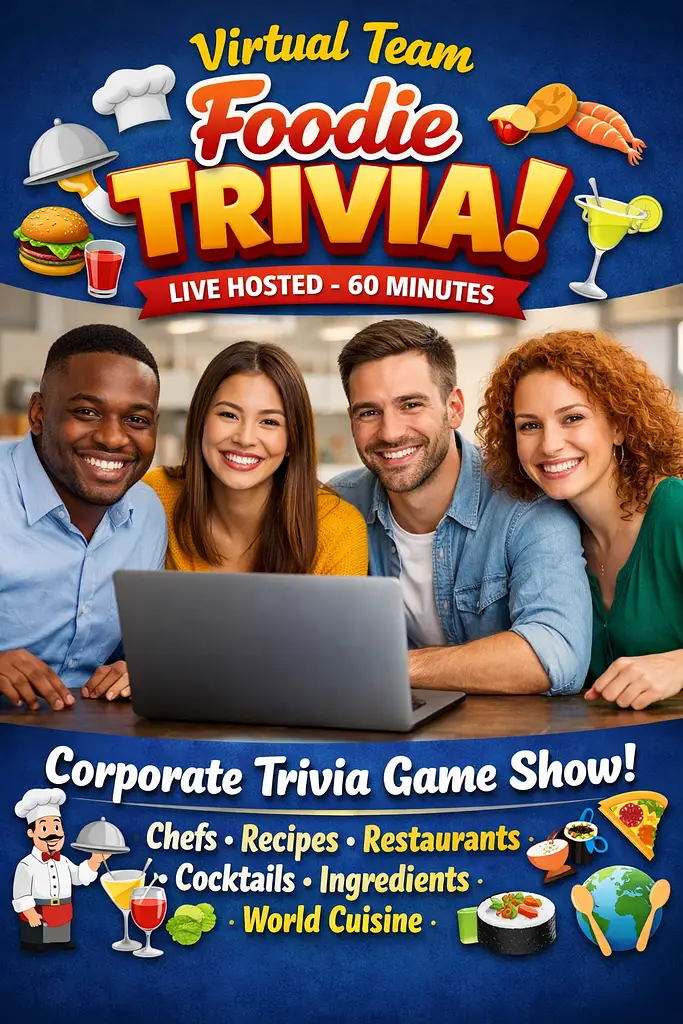 Check Availability & Book
Check Availability & Book
Check Availability & Book
Why Foodie Trivia Is the Most Fun Virtual Team Activity
August 11, 2025 7 min read
We have hosted hundreds of virtual team events across every theme you can imagine. Music, movies, sports, holidays, general knowledge. They all work. But foodie trivia has a quality that sets it apart from every other format: it makes people talk.
Not just answer questions. Talk. Share opinions. Debate. Tell stories. Reveal things about themselves that never come up in a standup meeting or a Slack thread. Food is personal in a way that most trivia topics are not, and that personal connection is what makes it the strongest team building format we offer.
Everyone Has a Food Story
Ask someone to name their favorite movie and they might hesitate, worried about being judged. Ask them about the best meal they have ever had and watch what happens. Their eyes light up. They describe the setting, the flavors, who they were with. The answer is not just a fact. It is a memory.
Foodie trivia taps into that storytelling instinct constantly. A question about regional barbecue styles does not just test knowledge. It triggers a debate about whether Texas or Carolina barbecue is better, which leads to someone sharing that their uncle runs a smokehouse in Memphis, which leads to someone else mentioning a hole-in-the-wall place in Kansas City that changed their life.
That chain reaction of personal sharing is incredibly rare in virtual team activities. Most formats generate answers. Foodie trivia generates conversations. We cover the question styles that spark the best conversations in our guide to the best food trivia questions for virtual team building.
About Your Host: Pop Culture Expert and Radio Host Scott Topper
The conversations that foodie trivia sparks need a host who knows how to nurture them without losing the pace of the game. Scott Topper is an Emmy Award-winning TV and radio host who brings professional broadcast energy to every virtual event. As a pop culture expert and radio host, Scott reads the room and knows when to let a great food conversation breathe and when to pull the group back into competition mode.
“Food stories are gifts,” Scott says. “When someone starts telling their team about their grandmother’s recipe or the street food they had in Bangkok, that is real connection happening. My job is to honor that moment and then transition back to the game so we keep the energy moving.”
🍕 Virtual Team Foodie Trivia Game Show
Categories include Chefs, Recipes, Restaurants, Cocktails, Ingredients, and World Cuisine Trivia!
$300 up to 10 people
$25 each additional participant
Food Crosses Every Cultural Boundary
One of the biggest challenges with virtual team building is creating an experience that feels inclusive for a globally distributed team. Not everyone celebrates the same holidays. Not everyone watches the same entertainment. Cultural references that land perfectly in one country can fall flat in another.
Food sidesteps this problem entirely. Every culture has a rich food tradition, and foodie trivia naturally celebrates that diversity. A question about dim sum connects to one teammate’s heritage. A question about injera connects to another’s. A question about pierogi brings in a perspective that might never surface in a typical work context.
When the trivia itself is a tour of world cuisines, the event becomes a celebration of the team’s diversity rather than a test that accidentally favors one cultural background. That cultural connection is also a big part of how foodie trivia brings remote teams together.
The Participation Floor Is Higher
In sports trivia, non-sports fans check out. In music trivia, people who do not follow current artists lose confidence. But in foodie trivia, there is no such thing as someone who has no food knowledge. Everyone has eaten thousands of meals. Everyone has ordered at restaurants. Everyone has a go-to comfort food.
That universal baseline means participation stays high throughout the event. Even someone who considers themselves a picky eater can contribute to a round about fast food history or candy brands. The barrier to entry is essentially zero, and that accessibility translates directly to engagement.
Pop culture expert and radio host Scott Topper has seen this pattern consistently. “In other trivia formats, you sometimes see one or two people on a team carrying the rest. In foodie trivia, the contributions are much more evenly distributed. The person who travels a lot dominates the world cuisine round. The home cook crushes the technique questions. The junk food enthusiast owns the brand identification round. Everyone gets a moment.”
Food Opinions Are Safe Opinions
In a corporate setting, people are careful about expressing strong opinions. But food opinions feel low-stakes enough that even the most reserved team members will jump in. “Pineapple on pizza: yes or no?” is the kind of question that gets the quietest person on your team talking.
This matters for team dynamics because it practices the muscle of disagreeing safely. When teammates argue passionately about whether a hot dog is a sandwich, they are learning how to hold opposing views without conflict. That skill transfers directly to workplace discussions where the stakes are higher.
The playful nature of food debates also reveals personality in a way that work conversations rarely do. The teammate who argues methodically about sauce consistency might approach project planning the same way. The teammate who gets creative with food combinations might be the one who brings unexpected ideas to brainstorming sessions. These insights are subtle but valuable.
Food Trivia Creates Real-World Follow-Through
After a music trivia event, people might share a playlist. After a movie trivia event, they might recommend a film. But after a foodie trivia event, something different happens. People share recipes. They recommend restaurants. They plan team lunches around cuisines that came up during the game.
That real-world follow-through extends the bonding well beyond the 60-minute event. A recipe shared in Slack becomes a recurring conversation. A restaurant recommendation becomes a team outing. A debate about the best ramen in the city becomes a standing joke that gives the team a shared identity.
“Food trivia has the longest tail of any format we host,” Scott says. “I hear from event organizers weeks later saying their team started a cooking channel in Slack, or that two teammates went to the Thai place that came up during trivia. The event keeps paying dividends.”
The Sensory Advantage
Even in a virtual setting, food trivia triggers sensory responses that other formats do not. When a question mentions a perfectly seared steak, people can almost smell it. When a photo of a beautifully plated dessert appears on screen, the visual response is immediate and visceral.
This sensory engagement keeps attention high in a way that abstract knowledge questions cannot match. People are processing food trivia with more of their brain, which makes the experience more immersive and more memorable.
The sensory element also creates natural energy peaks. A round of visually stunning dish identification photos generates audible reactions. A question that requires teams to guess an ingredient by description creates a puzzle that engages multiple senses. These moments punctuate the event and prevent the energy from plateauing. We break down which foodie trivia categories get every team talking and how to sequence them for maximum impact.
See It in Action
Our Foodie Trivia Game Show is a 60-minute live-hosted experience covering world cuisines, celebrity chefs, cooking techniques, food history, and beverage culture. Hosted by Emmy TV and Radio Host Scott Topper, every round is designed to maximize the conversations and connections that make foodie trivia special.
🍕 Virtual Team Foodie Trivia Game Show
Categories include Chefs, Recipes, Restaurants, Cocktails, Ingredients, and World Cuisine Trivia!
$300 up to 10 people
$25 each additional participant