
Team Building 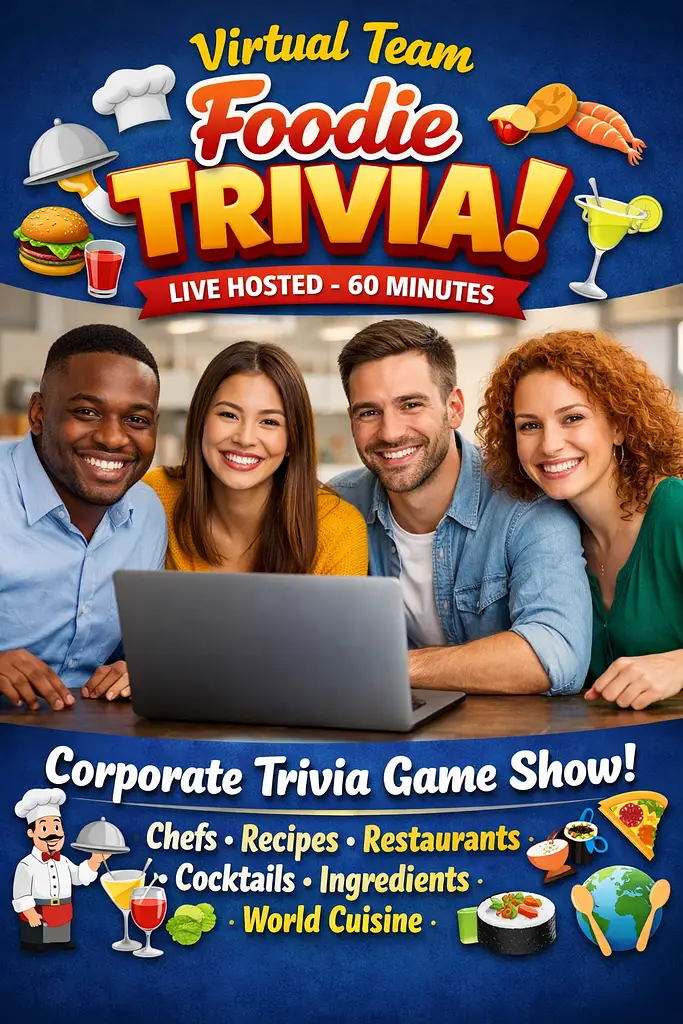 Check Availability & Book
Check Availability & Book
Check Availability & Book
How a Live-Hosted Foodie Trivia Night Brings Remote Teams Together
February 23, 2026 7 min read
One of the first things remote teams lose is the shared meal. No more grabbing lunch together. No more coffee run conversations. No more debating where to order from for the team dinner. Those small food moments are where a surprising amount of real relationship building happens, and remote work quietly eliminates all of them.
Foodie trivia brings that energy back. Not by replacing the shared meal, but by recreating the conversations that happen around it. Over 60 minutes of food-themed competition, teams discover who on their team is a secret chef, who has the most adventurous palate, and who has opinions about pizza that border on religious conviction.
Those discoveries matter. They are the building blocks of the informal relationships that make teams actually function.
Why Food Creates Connection Faster Than Other Topics
Psychologists have studied why sharing food creates bonds between people. The short version: food is tied to survival, memory, and identity in ways that other experiences are not. When you learn what someone eats, what they cook, and what food means to them, you learn something fundamental about who they are.
Foodie trivia taps into this dynamic without the awkwardness of forced sharing. Nobody is asked to “tell the group about a meaningful food experience.” Instead, a question about the best barbecue region naturally prompts someone to defend their hometown’s style, which reveals where they grew up, which opens a conversation that would never happen in a project review meeting.
The information exchange feels organic because it is. The trivia provides the prompt. The personal sharing happens on its own. The right question styles make all the difference, which is why we put together a guide to the best food trivia questions for virtual team building.
About Your Host: Pop Culture Expert and Radio Host Scott Topper
Building team connection through trivia requires a host who understands that the game is a vehicle for something larger. Scott Topper is an Emmy Award-winning TV and radio host who has hosted over 500 virtual events. As a pop culture expert and radio host, Scott recognizes the moments when trivia becomes connection and knows how to amplify them.
“I watch for the moments when someone’s answer reveals something personal,” Scott says. “When a team member lights up about a question on Vietnamese pho and starts describing the spot near their apartment, I give that moment space. Then I bring it back to the game. That balance between personal connection and competitive energy is what makes these events work.”
🍕 Virtual Team Foodie Trivia Game Show
Categories include Chefs, Recipes, Restaurants, Cocktails, Ingredients, and World Cuisine Trivia!
$300 up to 10 people
$25 each additional participant
The Kitchen Table Effect
There is a reason some of the most important conversations in life happen around a kitchen table. Food creates a psychological context of comfort, openness, and informality that other settings do not provide.
Foodie trivia recreates this context virtually. When teams are discussing whether Chicago deep dish or New York thin crust deserves the crown, the formality of the workplace dissolves. People speak more freely, laugh more easily, and reveal more of their personality than they would in any structured team building exercise.
This effect is especially powerful for teams that include new hires or members who joined after the shift to remote work. These team members often struggle to break through the professional distance that virtual communication creates. A foodie trivia night gives them a natural entry point to participate, share opinions, and be seen as a person rather than just a name on a screen.
Cultural Connection Through Cuisine
For globally distributed teams, food trivia becomes a celebration of the team’s diversity. When a question about injera comes up and an Ethiopian team member gets to explain the significance of the bread in their culture, something shifts. The team member feels seen, and the rest of the team gains genuine cultural understanding that no diversity training PowerPoint could achieve.
These moments accumulate throughout the event. A question about dumplings might connect to a teammate’s Chinese heritage. A question about pupusas might reveal a Salvadoran background. A question about fika connects to someone’s time living in Sweden. Each answer becomes a small window into a colleague’s life and culture. We cover the specific foodie trivia categories that get every team talking so you can build events around this dynamic.
Pop culture expert and radio host Scott Topper finds that food is the single most effective topic for cross-cultural team building. “People are proud of their food traditions in a way that feels comfortable to share. There is no awkwardness. Someone lights up when their culture’s cuisine comes up, and their teammates lean in because the information is genuinely interesting.”
Hidden Expertise and Unexpected Heroes
Every team has a “food person” who everyone knows about. But foodie trivia consistently surfaces expertise that nobody expected. The quiet developer who turns out to have an encyclopedic knowledge of cheese. The project manager who spent years in the restaurant industry before changing careers. The new hire who grew up on a farm and knows more about produce than anyone in the room.
These discoveries are valuable beyond the trivia itself. When a team learns that their colleague has unexpected depth in an area outside of work, it changes how they see that person. The relationship becomes more three-dimensional. People are no longer just their job title and their Slack messages. They are someone who makes their own pasta from scratch or who can identify a wine region by taste.
That expanded understanding of teammates improves collaboration in subtle but measurable ways. People communicate more freely with colleagues they feel they know as whole people. They give more benefit of the doubt. They ask for input more readily. The trivia night is 60 minutes, but the relational gains compound over months.
Food Debates Build Team Communication Skills
One underappreciated benefit of foodie trivia is that it practices group decision-making in a low-stakes context. When a team needs to agree on an answer, they are essentially running a mini version of the same process they use in meetings: presenting evidence, evaluating options, managing disagreement, and committing to a decision under time pressure.
Food topics make this process more animated than other trivia themes. People have genuinely passionate opinions about food, and that passion creates more robust debate. A team that argues enthusiastically about whether a tomato is a fruit or a vegetable is practicing the same communication muscles they need when debating a product feature or a project approach.
The low stakes are crucial. Nobody’s performance review depends on knowing whether a croissant is technically considered a pastry or a bread. That safety allows people to practice asserting opinions, backing down gracefully, and supporting a team decision even when they disagree. Those are exactly the skills that make teams function better day to day.
The Post-Event Ripple
Foodie trivia generates more follow-up activity than any other trivia format we host. Within days of an event, organizers consistently report new activity in team channels: recipe sharing, restaurant recommendations, cooking challenges, and food photos.
This ripple effect happens because food is an ongoing part of daily life in a way that other trivia topics are not. After a music trivia event, you might share a playlist. After a foodie trivia event, you might actually cook the dish that came up, share the result, and start a conversation that pulls in other team members.
“The longest-lasting team connections come from foodie trivia,” Scott says. “I have had organizers tell me their team started a weekly recipe exchange that ran for months after the event. That kind of sustained engagement from a single 60-minute activity is remarkable.” It is also why foodie trivia is the most fun virtual team activity according to the teams we work with.
Bring Your Team to the Table
Our Foodie Trivia Game Show is designed to create every one of these connection moments. World cuisines, celebrity chefs, cooking techniques, food history, and beverage culture, all wrapped in a live-hosted, Family Feud-style competition. Emmy TV and Radio Host Scott Topper keeps the energy high and the conversations flowing for a full 60 minutes.
🍕 Virtual Team Foodie Trivia Game Show
Categories include Chefs, Recipes, Restaurants, Cocktails, Ingredients, and World Cuisine Trivia!
$300 up to 10 people
$25 each additional participant